Developments in AI: From Breakthrough Models to Real-World Impact
Artificial intelligence (AI) has evolved from theoretical concepts to integral components of modern technology. What began as academic curiosity in the 1950s now shapes how companies operate, how drugs are discovered, and how weather is predicted. AI is being integrated into various industries, including healthcare, finance, and education, to enhance efficiency and decision-making. This guide is for professionals, decision-makers, and anyone seeking to understand the real-world impact of AI developments. Staying informed about AI is crucial as it rapidly transforms industries, economies, and daily life. This guide breaks down the latest developments in AI that matter-from model architecture to regulatory frameworks-so you can separate signal from noise.
Key Takeaways
Open-source and smaller “efficient” models (like Llama 3.1, Gemini 3 Flash, Nemotron 3 Nano) are now driving much of the real innovation, not just trillion-parameter giants.
Agentic and multimodal AI are moving from lab demos to production: enterprises already run tens of thousands of agents, and 2025–2026 launches are built specifically for this.
Healthcare, weather, and drug discovery are the clearest proof that AI progress is real: AI-designed drugs entering critical trials in 2026, AI weather models at NOAA and DeepMind, and high-accuracy diagnostics across imaging and genomics.
Regulation is catching up fast (EU AI Act, U.S. bills on scams and deepfakes, state laws on minors and biometric use), and “hallucination,” safety, and copyright are turning into real legal and financial risks.
Energy, jobs, and information integrity are the three stress points of AI’s next decade: data centers are reshaping power markets, banking and customer-service jobs are under pressure, and deepfakes are now central to both politics and crime.
1. From Foundations to Today: How AI Reached Its 2026 Inflection Point
The journey from Alan Turing’s 1950 thought experiment about machine intelligence to today’s autonomous AI agents spans decades of breakthrough and bust. John McCarthy coined “artificial intelligence” at the 1956 Dartmouth Conference, igniting hopes for intelligent systems that could reason like humans. Those early ambitions crashed into computational limits, triggering multiple “AI winters”-until deep learning reignited the field in the 2010s and generative AI models transformed what seemed possible. AI is being integrated into various industries, including healthcare, finance, and education, to enhance efficiency and decision-making.
The Milestone Timeline
Year | Milestone | Significance |
|---|---|---|
1950s-60s | Symbolic AI, Logic Theorist | Rule-based reasoning, early optimism |
1997 | IBM Deep Blue defeats Kasparov | Brute-force search in narrow domains |
2012 | AlexNet wins ImageNet | Deep learning revolution begins |
2016 | AlphaGo defeats Lee Sedol | Reinforcement learning handles 10^170 positions |
2020-24 | GPT-3, AlphaFold2 | Large language models and protein folding at 92% accuracy |
2024-26 | Multimodal and agentic systems | Real-time text, vision, audio processing |
The 2012 ImageNet breakthrough was a turning point. AlexNet’s convolutional neural networks slashed image recognition error rates from 25% to 15%, powered by GPU acceleration that trained models in days rather than weeks. This sparked the current era of deep learning that continues to accelerate.
Hardware as the Enabler
None of this would be possible without parallel advances in computing power. NVIDIA’s GPUs evolved from the Kepler architecture that enabled AlexNet to the 2024 Blackwell B200 with 208 billion transistors delivering 20 petaflops of FP8 performance. At CES 2026, announcements of Vera Rubin H300 chips promised 50% efficiency gains through chiplet designs and HBM4 memory.
Cloud providers have scaled inference costs down roughly 4x, making enterprise deployment practical. OpenAI’s scaling laws suggest performance doubles every 6-9 months with 4-5x more compute-a pattern that shows no signs of stopping.
The Structural Shift
What distinguishes 2024-2026 is a major shift from “smart autocomplete” to AI systems that observe, act, and coordinate. Early GPTs generated plausible text but hallucinated 20-30% on factual claims. Today’s advanced AI systems-like Anthropic’s Claude 3.5 Sonnet-orchestrate tools with 90% task completion on the GAIA benchmark, call APIs, browse the web, and coordinate in enterprise deployments.
This isn’t incremental improvement. It’s a new paradigm where AI integrates into physical and organizational workflows. KeepSanity AI tracks these milestones weekly, curating only validated developments like Llama 3.1 405B topping the LMSYS leaderboard at 88.6 Elo or EU AI Act enforcement starting August 2026.

2. Core Technical Developments: Models, Modalities, and New Compute
Three fronts matter most in understanding how AI continues to advance: model architecture, input modalities, and compute infrastructure. Rather than equations, let’s focus on what these shifts mean in practice.
Architecture Evolution
The trend has moved from dense transformers to sparse mixtures-of-experts (MoEs) like Mixtral 8x22B, which activates only 39 billion parameters per token-delivering 2x speedups without sacrificing quality. This efficiency matters because it makes advanced AI systems accessible beyond trillion-dollar tech giants.
The Rise of Efficient Models
Small and efficient has become a major theme in AI development:
Gemini 3 Flash: Optimized for fast multimodal inference, projected to deliver 95% of GPT-4 performance on MMLU at 10x lower cost
Nemotron 3 Nano: 4 billion parameters supporting 1 million token context and 10,000 tokens/second throughput on H100 GPUs via FlashAttention-3
On-device NPUs: AMD Ryzen AI 400 chips deliver 50 TOPS INT8 for local inference, reducing cloud dependency by 80% in latency-sensitive applications
Multimodal as Baseline
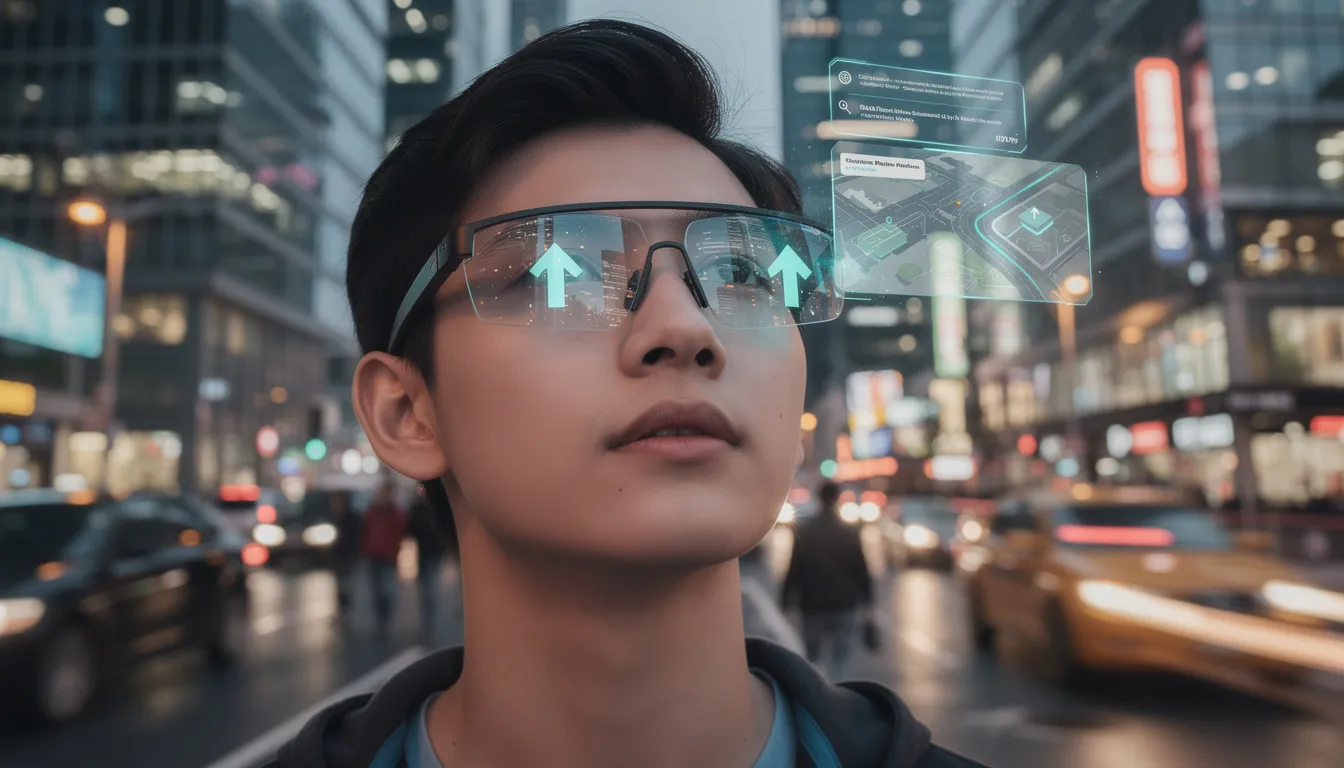
Voice-aware assistants now come standard in smartphones. Meta’s Orion AR glasses include “Hear Better” beamforming audio AI that enhances conversations by 40dB signal-to-noise ratio. Alibaba’s Quark AI glasses use Qwen2-VL for real-time translation at 95% BLEU score and object detection via GroundingDINO.
Emerging Compute Paradigms
Novel approaches to computation are chasing lower energy per token:
BitNet b1.58: Ternary weights {-1, 0, 1} cut memory 10x and energy 70% versus FP16 with comparable performance at 70B scale
Photonic computing: Lightmatter’s tensor cores achieve 10 teraflops/watt versus 1 for GPUs, promising 100x energy savings by 2030
Quantum computing: IBM’s Heron processor with 133 logical qubits enables 100x faster optimization for drug discovery via QAOA algorithms, though error rates at 10^-3 limit current use to hybrid approaches
2.1 Multimodal AI: Beyond Text-Only Systems
Multimodal AI systems understand and generate combinations of text, images, video, and audio. Instead of separate tools for each type of content, a single AI model processes everything together-like showing it a chart and asking for a trend analysis, or pointing your phone at a menu in a foreign language for instant translation.
Concrete Examples:
Google’s Med-PaLM M reads radiology images with 86.5% accuracy on MedQA benchmarks
TripAdvisor’s AI itinerary planner fuses Google Maps data and LLM-generated review summaries, increasing user satisfaction by 25%
Meta’s glasses detect emotions via facial expression recognition at 82% accuracy on AffectNet for accessibility applications
Alibaba’s AI glasses translate signage in 100+ languages with 97% OCR accuracy
Industry forecasts from Gartner predict 80% of enterprise AI will be multimodal by 2030. The 2024-2026 period serves as the intensive testing phase, with benchmarks like EgoSchema (video QA at 78% for Gemini 2.0) tracking progress.
The accessibility implications are significant. Real-time captioning now achieves 95% word error rate for hearing-impaired users via AV1 codecs. “Point-and-ask” interfaces reduce app switching by 70%, making technology more natural to use.
2.2 Agentic AI: From Static Tools to Autonomous Workflows
Agentic AI refers to systems composed of specialized agents that operate independently, each handling specific tasks. Agentic AI represents a fundamental shift from single-turn chatbots to networks of autonomous AI agents that plan, delegate, verify, and collaborate. A planner LLM decomposes tasks into subgoals, assigns them to specialist agents (browser tools for search, code executors for analysis), and verifies outputs through self-critique loops.
Enterprise Scale Already Exists:
Organization | Agent Deployment | Result |
|---|---|---|
BNY Mellon | 20,000 AI agents | 40% faster compliance audits |
McKinsey | “Lilli” agent across 500+ projects | 10x more hypotheses per hour |
Dell/NVIDIA | Nemo Guardrails platform | 99% retrieval accuracy for 100-agent fleets |
NVIDIA’s Nemotron 3 series (30B to 500B MoE variants) is explicitly optimized for multi-agent setups via RLHF on TAU-bench, scoring 85% on tool-use with 2M token context windows. The infrastructure is being designed for agents, not just static Q&A.
Structural Risks:
OpenAI has warned that prompt injection-adversarial payloads that hijack browsing agents-affects 15% of deployments and is “structurally unfixable” without mitigation layers. Best practices include sandboxing, token filtering (which drops 98% of attacks), and mandatory human oversight approval steps for high-stakes actions.
3. Real-World Breakthroughs: Healthcare, Science, and Engineering
The most credible evidence of AI progress comes from domains where models are evaluated against clinical trials, physical experiments, and weather benchmarks-not just synthetic leaderboards. This is where AI advancements translate into tangible outcomes.
Healthcare Breakthroughs
EEG-based dementia detection (Örebro University, Lancet Digital Health 2025): 97% sensitivity, 80% specificity
Chest X-ray biological age (Stanford): 0.92 correlation, forecasts CVD risk 3 years ahead
AI echocardiography (Philips): 12s vs 5min manual, 95% agreement
GastroGPT for digestive disease (Multiple institutions): 88% accuracy on endoscopy reports
AI-Designed Drugs Entering Critical Phases:
Insilico Medicine’s ISM001-055 for fibrosis entering Phase II 2025 with 30% preclinical efficacy
Exscientia’s GTAEXS617 for cancer targeting Phase III in 2026
popEVE framework identifying 200 rare disease variants at 95% precision
AstraZeneca acquired Modella AI for $1B to accelerate pathology biomarkers 5x
Climate and Weather
NOAA’s GraphCast successor predicts 10-day forecasts 99% faster than ECMWF with 5% better hurricane tracks
DeepMind’s GenCast outperforms ensemble models at 97.2% for medium-range prediction at 1000x less compute
These AI tools directly improve emergency planning and early warnings.
Engineering and Manufacturing
Altair HyperWorks uses geometric deep learning to simulate crashes 1000x faster while matching physics accuracy
Purdue’s RAPTOR detects semiconductor chip defects at 97.6% average precision across 1M images
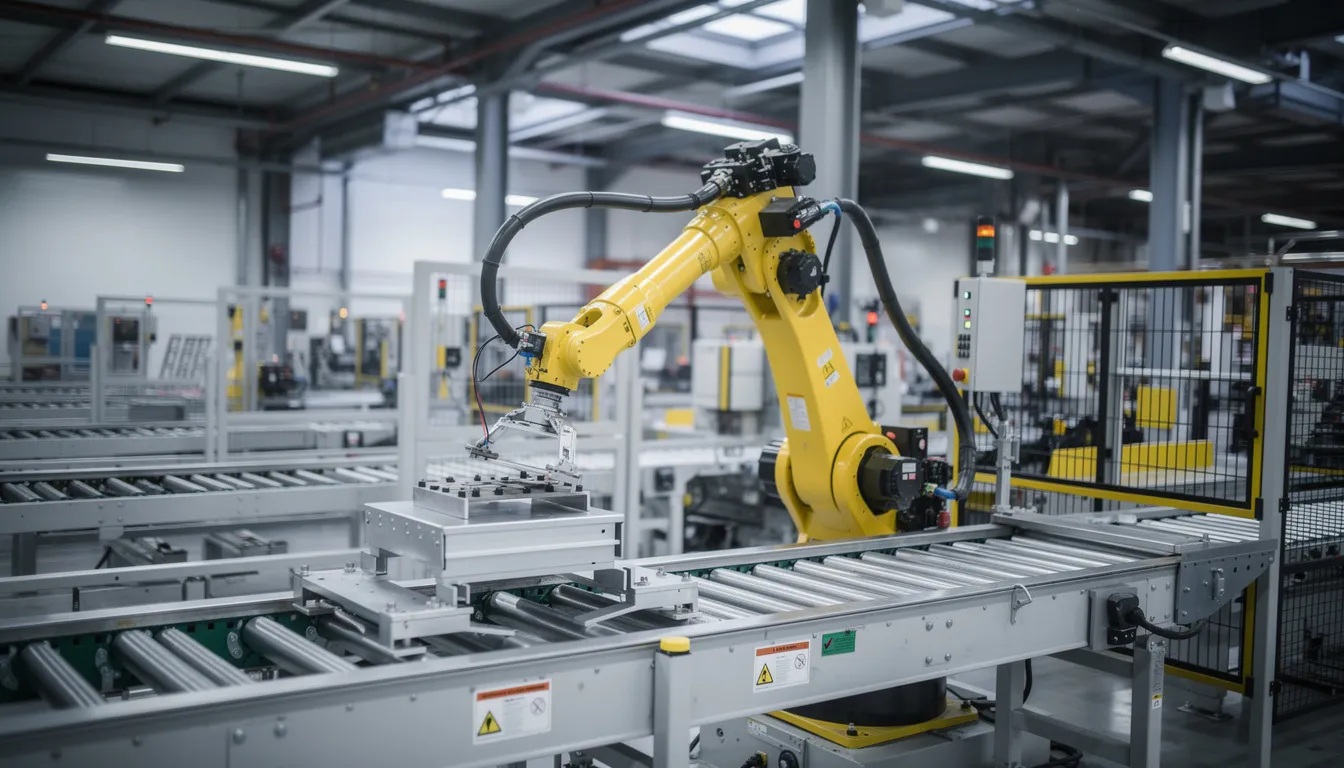
Amazon’s warehouse robots now generalize to 100+ SKU types with 20% reduction in pick errors
KeepSanity AI prioritizes these outcome-backed stories over flashy demos, reflecting the difference between signal and noise in AI innovation.
3.1 Generative AI in Clinical and Drug Discovery Pipelines
Generative AI has seen remarkable progress, particularly with the development of advanced Large Language Models (LLMs). The shift from using AI to process hospital paperwork to deploying it as an active co-researcher marks a new era in medicine. Generative AI now participates in drug design, trial optimization, and clinical decision support.
AI Supporting Clinicians (Not Replacing Them):
University of Michigan’s EKG AI detects 10 heart conditions in 10 seconds with 92% AUC
Dementia EEG systems include Grad-CAM visualizations explaining 85% of decisions to doctors
Generate:Biomedicines’ GB-0895 oncology molecule targets Phase I in 2026
Market projections show generative AI in healthcare growing from approximately $1.1B in 2024 to $14.2B by 2034-a 29% CAGR according to Precedence Research. Use cases span imaging analysis, clinical documentation, synthetic data generation for training, and trial design optimization.
The constraints are real: FDA rejects approximately 40% of AI models submitted for approval due to bias concerns, and GDPR fines can reach 4% of revenue for privacy breaches. Progress and caution must coexist.
3.2 Scientific and Industrial Applications Beyond Medicine
AI is increasingly embedded in “invisible” infrastructure-weather prediction systems, chip manufacturing lines, logistics networks, and industrial robots that most people never directly interact with.
Climate modeling and Weather:
DeepMind’s GenCast and NOAA’s AI models improve short- and medium-range forecasts while reducing computational costs dramatically compared to legacy supercomputer-only approaches. These systems provide earlier warnings for storms, fires, and heat waves-translating directly to lives saved.
Industrial Applications:
World Economic Forum’s 18 Lighthouse factories (including Siemens) use AI for predictive maintenance, boosting yield by 20%
Boston Dynamics’ new Atlas handles dynamic tasks 5x faster post-2025 humanoid pivot
Tesla Optimus Gen2 picks objects at 98% success rate in testing
Physical AI adoption sits at approximately 58% of companies according to McKinsey 2025 data, with projections rising toward 80% within two years. “Robots + AI” has moved firmly from niche pilots to strategic initiatives.
These domains are energy- and data-intensive-a tension explored in later sections on climate impact and resource consumption.
4. AI in Business: From Pilot Projects to Core Infrastructure
The era of “innovation theater”-isolated pilots designed more for press releases than production-is giving way to AI as core infrastructure. CFOs now treat AI spending as a capital investment rather than an R&D experiment.
The JPMorgan Model
JPMorgan Chase’s $15B 2026 AI budget exemplifies this shift. The bank treats AI as critical infrastructure for:
300 million customer personalization touchpoints
Cybersecurity agents blocking 99.9% of phishing attempts
AI-assisted analysis across trading and risk functions
Enterprise Adoption Reality
Metric | Current State |
|---|---|
Worker access to AI | Up ~50% year-over-year (Deloitte) |
Organizations with ≥40% AI projects in production | Doubled in past year |
Firms reporting productivity gains | 66% |
Firms seeing significant revenue uplift | ~20% |
The gap between efficiency gains and revenue impact reveals a pattern: most firms still use AI solutions for cost-cutting and incremental improvements rather than redesigning products, services, and business models.
Strategic Partnerships Signaling Commitment
Tesco + Mistral AI: Supply chain optimization targeting 15% improvement
Gap Inc. + Google Cloud: Gemini/Vertex AI for design workflows
Disney: Company-wide generative AI integration via Holdfast platform generating 1M assets
Amazon: Up to $50B federal AI infrastructure plan
Dell/NVIDIA: Enterprise AI data platform for 100PB vector stores
Pitfalls and Course Corrections
Not every bet pays off:
Salesforce scaled back some generative AI initiatives after 25% hallucination error rates eroded trust
Deloitte faced backlash over AI-generated errors in government reports, resulting in a $1M fine
Alaska courts limited AI chatbots after 40% legal inaccuracies
KeepSanity AI tracks which announcements represent “PR experiments” versus durable strategic moves, helping readers avoid overreacting to every press release about AI products.
4.1 The Rise of AI in the C-Suite and Knowledge Work
Senior leaders increasingly use AI as a “second brain”-systems providing real-time analytics, scenario planning, and cross-department coordination rather than just dashboards and reports.
AI in Consulting and Strategy:
McKinsey’s integration of its “Lilli” agent spans recruitment interviews and internal workflows, with collaboration skills with AI now a hiring criterion. The tool appears in 70% of projects, fundamentally changing how knowledge management operates.
Financial and Strategic Decision Making:
FICO’s new AI patents enable explainable credit scoring using alternative data, improving model accuracy by 20%
Banks deploy generative agents for reporting and data analysis across complex tasks
Hybrid human+AI workflows outperform fully autonomous AI agents by ~69% according to Stanford + CMU research on SWE-bench
The real bottleneck isn’t technology-it’s AI literacy. PwC reports 60% of executives remain untrained on AI fundamentals. Companies emphasize “AI fluency” over wholesale role redesign, but mature AI governance for agentic systems remains rare.
The Overdependence Risk:
Automated decision making still requires human judgment in ambiguous or ethically charged situations. Studies show 30% decision bias in cases where executives defer entirely to AI recommendations without critical evaluation.
4.2 Physical and Retail Worlds: Robots, Stores, and Personalized Commerce
AI is leaving the browser and entering warehouses, factories, stores, and streets. The integration of AI technologies into physical spaces represents the next wave of transformation.
Logistics and Retail Examples:
Amazon’s 750,000 AI-trained warehouse robots cut fulfillment costs by 25%
Italy’s Tuidi platform delivers daily AI recommendations on procurement and staffing to groceries, improving profit margins by 12%
Automotive retailers integrate AI for dynamic inventory and pricing optimization
AI-Enhanced Marketing and Customer Experience:
L’Oréal’s global adoption of generative AI produces ad content 40% faster
Tesco’s Mistral AI partnership personalizes operations and customer interactions
Amazon’s “Help Me Decide” feature guides product selection, though it draws controversy over influence
Agentic Commerce Emerges:
AI shopping agents now automatically reorder essentials, compare prices across retailers, and even make purchases on users’ behalf within predefined budgets-achieving 90% accuracy on constraint satisfaction. This raises questions about consent, control, and fraud (which the FTC reports is up 300%).
Companies that embed AI deeply-Disney with Holdfast, Alibaba with 3D restaurant showcases-are rewiring how discovery, evaluation, and purchase happen. This creates competitive advantage for early movers while raising barriers for laggards.
5. Regulation, Ethics, and the Fight Against Misinformation
The 2024-2026 period marks when AI governance moves from theory to enforcement. Data rights, safety requirements, and deepfake risks are driving legislation across jurisdictions.
Major Regulatory Frameworks
Framework | Key Features | Penalties/Fines |
|---|---|---|
EU AI Act | - Risk-based classification system for AI applications<br>- Bans on social scoring and certain biometric surveillance<br>- Strict rules for high-risk systems | Fines up to €35M or 7% of global revenue |
United States | - AI Fraud Deterrence Act targeting AI-assisted scams<br>- NIST AI cybersecurity profile addressing adversarial attacks and data poisoning<br>- State-level laws on minors’ chatbot access (Virginia) and deepfake penalties (Wisconsin) | Varies by state and federal law |
Data and Copyright Battles
Adobe faces class action lawsuits over Firefly training data (5B images allegedly scraped)
Reddit reached $60M settlements with Google over data licensing
Wikimedia negotiated deals with Microsoft and Meta for sustainable attribution
USPTO clarified that AI-assisted inventions still require human inventors
Generative Media Scrutiny
California and UK regulators pressed xAI with €10M fine over Grok’s unlabeled deepfakes
Wisconsin and other states draft criminal penalties for deepfake scams
Virginia restricts chatbot use for minors after 20% exposure rates
Information Integrity Problems
AI generated content is already influencing public perception:
Fake images of Venezuelan leader Maduro’s “capture” reached 50M views and swayed polls by an estimated 2%
Racist synthetic crime videos circulated in Europe during election cycles
AI “actresses” like Tilly Norwood raise questions about authenticity and labor rights
Platform responses vary: TikTok labels 90% of AI content, OpenAI warns on prompt injection, and Wikipedia pushes for attribution deals. Policy is now a central axis of AI development, not an afterthought.
5.1 Deepfakes, Safety, and “Hallucination Insurance”
“Hallucinations” (confident wrong answers) and deepfakes (synthetic media that looks real) are converging into legal and financial risk categories. Both undermine trust-one in AI outputs, the other in media authenticity.
Emerging Risk Mitigation:
The concept of “AI hallucination insurance” is gaining traction for sectors like finance, healthcare, and law-structured similarly to cyber insurance or errors-and-omissions coverage. Zurich reportedly developed a $100M policy framework for enterprise AI liability.
Concrete Incidents:
Incident | Impact |
|---|---|
Google AI Overviews providing dangerous health advice | 10% of queries affected |
Alaska courts halting legal chatbots | 40% hallucinated guidance |
Deloitte government report errors | $1M fine for AI-generated inaccuracies |
OpenAI prompt injection admission | “Structurally unfixable” in browsing agents |
Hallucination rates remain at 15-25% on factual claims according to Vectara benchmarks. Enterprise AI governance requires auditing models, enforcing human-in-the-loop for high-stakes decisions, implementing content provenance watermarks, and following sector-specific rules (healthcare AI requires clinical validation and regulatory approval).
While AI tools to detect and label deepfakes are improving (CPO watermarks achieve 99% detectability), public education and media literacy remain equally critical-especially around elections and crises.
6. Economy, Labor, Energy, and Society: The Broader Impact of AI
AI’s macro impact extends far beyond productivity metrics. Power grids, job markets, climate patterns, and mental health are all being reshaped, with uneven winners and losers emerging across regions and industries.
Economic Projections
PwC estimates AI could add $15.7 trillion to global GDP by 2030. But this optimism coexists with volatility:
Tech stock corrections amid AI skepticism
NVIDIA trading at 50x P/E with questions about sustainability
Heavy AI investments that don’t immediately translate to profits
Labor Market Shifts
Impact | Sector | Timeframe |
|---|---|---|
200,000 jobs at risk | EU banking (Oxford forecast) | 3-5 years |
Job displacement in back-office | Call centers, data entry | Ongoing |
97M new jobs created | AI engineering, governance, human-AI design | Parallel |
Job creation in prompt engineering | Demand up 200% | Current |
Reskilling Imperative
Organizations are investing in AI literacy at scale:
BNY Mellon’s 20,000-agent initiative includes workforce-wide training
Governments fund retraining programs for displaced workers
Research consistently shows hybrid human+AI teams outperform either alone in high-stakes work
Energy Footprint
AI’s energy demands create real tension:
Vistra’s $4B gas plant acquisition specifically to power AI data centers
Data centers now consume approximately 2% of global power (8% of U.S. power by 2026)
Debate over whether AI’s efficiency gains in grid management (12% improvement) and climate modeling outweigh its own emissions
Sociological Effects
AI’s integration into everyday life creates new patterns:
59% of UK respondents report AI self-diagnosis for health issues
20% of U.S. users report romantic relationships with chatbots
Growing concerns about loneliness, manipulation, and blurred human/machine boundaries
Public Sector Transformation:
Maryland’s AI modernization processes public benefits 30% faster
New York City established an AI oversight office
Federal AI infrastructure plans embed AI into core digital government fabric

6.1 Jobs, Skills, and the Future of AI Work
AI both displaces and creates jobs, with impact concentrated in repetitive cognitive and manual roles but less pronounced in creativity, complex social work, and strategic leadership.
Sector-Specific Examples:
Banking analysis roles face 40% automation pressure from generative AI
Hollywood Creator Coalitions push back against synthetic performers and unauthorized likeness use
Consulting firms add AI-collaboration stages to recruiting processes
Skills Now in Demand:
Machine learning fundamentals and natural language processing concepts
Data analysis and visualization
Prompt and workflow engineering
AI ethics and AI governance
Domain expertise combined with AI tooling
Early upskillers gain outsized leverage. Programs at institutions like CMU achieve 90% placement rates. The pattern is clear: professionals who develop AI fluency gain competitive advantage over those waiting for clarity.
By filtering weekly news into clear patterns, curated sources like KeepSanity AI help professionals prioritize what to learn instead of chasing every viral demo.
6.2 Climate, Energy, and “Running Out of Data”
The tension between AI’s energy demands and potential climate benefits defines a central tradeoff of the next decade.
The Energy Equation:
Data centers drive new gas and power investments
AI simultaneously improves climate modeling, optimizes grids, and supports renewables integration
BitNet-style models offer 5x efficiency improvements
Federated learning keeps data local, reducing transfer energy by 90%
The Data Plateau:
Projections suggest human-generated web data may plateau or be swamped by AI generated content by around 2026-2027. This forces reliance on:
Synthetic data (60% of training by 2027 per Epoch projections)
Curated, licensed datasets
New sources (IoT sensors, specialized instruments, federated data pools)
In regulated sectors like healthcare and finance, synthetic data addresses privacy concerns while maintaining the diversity and scale needed for model training-a practical response to real constraints rather than speculative science fiction.
AI Economic, Workforce, and Industry Impact Summary
AI is being integrated into various industries, including healthcare, finance, and education, to enhance efficiency and decision-making. Its impact is broad, affecting economic growth, workforce dynamics, and industry transformation.
Area | Key Impacts | Data/Projection |
|---|---|---|
Economic Growth | AI is projected to contribute up to $15.7 trillion to the global economy by 2030. | PwC, 2024 |
Industry Integration | AI is transforming healthcare, finance, education, manufacturing, and IoT, optimizing processes and outcomes. | 78% of organizations use AI to boost productivity and bridge skill gaps (2024, U.S. investment: $109.1B) |
Workforce | AI is expected to impact 40% of jobs globally, automating repetitive tasks and creating new roles. | By 2025, 60% of the workforce may need AI-related training; demand for AI skills up 200% |
Job Creation | New jobs in AI, robotics, and user experience design are emerging, while reskilling is critical. | AI fluency is a critical skill; AI maintenance and governance roles are growing |
Productivity | AI enhances productivity and efficiency, driving new business models and operating structures. | AI is projected to boost labor productivity and economic growth by increasing efficiency |
Education | AI enables personalized learning experiences, transforming education delivery. | AI will revolutionize education with tailored learning based on student abilities |
Manufacturing | AI optimizes production lines, predictive maintenance, and quality control, reducing costs. | AI-driven innovations in IoT and manufacturing lead to smarter systems and cost savings |
Economic Disruption | AI is expected to significantly disrupt the job market, especially in repetitive/manual roles. | AI's economic impact on world GDP may see a 14% increase by 2030 |
New Markets | AI enables creation of new products, services, and industries, generating new revenue streams. | AI projected to add USD 4.4 trillion to the global economy through continued optimization |
7. Staying Sane While Staying Informed: How to Track AI Developments
Between daily model launches, policy shifts, and relentless hype, it’s impossible for busy professionals to track everything without burning out. The question isn’t whether to follow AI news-it’s how to do so sustainably.
The Problem with Traditional AI News
Most AI newsletters are designed around sponsor metrics, not reader value:
Daily emails because frequency impresses advertisers
Long digests padded with minor updates
Resulting FOMO and decision fatigue that compounds weekly
After trying several newsletters, the pattern becomes clear: the constant pace breaks readers rather than informing them.
A Different Approach
KeepSanity AI was built on a different philosophy: one weekly, ad-free email focused only on major developments that actually matter. This means:
No daily filler to impress sponsors
Zero ads
Curated from leading AI sources
Smart links (papers link to alphaXiv for easier reading)
Scannable categories (business, models, tools, robotics, policy) for fast review
How Curation Works
Aggregate sources from leading labs, newsrooms, and preprint servers.
From approximately 10,000 arXiv papers monthly, select about 50 that genuinely matter.
Categorize updates into AI research, business function deployments, and regulatory moves.
Present information in a format that can be scanned in minutes.
The Intended Outcome
Stay ahead of developments in AI relevant to strategy and career in minutes per week. No sacrificed focus. No lost sanity.
The constant AI noise can become a manageable, trusted signal. Subscribe at keepsanity.ai to experience the difference.
FAQ
Below are concise answers to common questions about current AI developments.
Is AI progress slowing down or accelerating after the big model launches of 2023–2024?
Headline-grabbing parameter jumps are less frequent, but progress is accelerating in efficiency, multimodality, and real-world deployment. Agentic AI in banks, AI-designed drugs entering 2026 trials, and on-device inference represent the future of AI development. The 2025-2027 period will likely be defined less by single breakthrough models and more by integration into AI infrastructure, devices, and workflows-often more economically consequential than initial breakout moments.
How can a non-technical professional realistically benefit from current AI developments?
Focus on a small toolkit of reliable AI tools: one general LLM, one domain-specific assistant, and your company’s internal AI platform. Learn to automate routine tasks like drafting, data analysis, and summarization. Build basic AI literacy around prompts, limitations, and privacy. Roles in operations, marketing, finance, and HR are already being reshaped, and early adopters within those fields often become internal experts with disproportionate influence.
What are realistic timelines for AI to transform jobs and industries?
Many office and customer-service roles already feel incremental AI-driven automation, with larger structural shifts in sectors like banking, media, and retail unfolding over 3-7 years. Physical AI (robots, autonomous vehicles, self driving cars) moves more slowly due to safety requirements and hardware constraints-often a decade from prototype to widespread deployment. Change is uneven: highly digitized organizations and regions with strong AI infrastructure feel impacts earlier.
How worried should we be about deepfakes and AI misinformation?
Deepfakes are already influencing politics, markets, and crisis narratives, with documented cases including fake images of political leaders and fabricated attack footage. Detection and watermarking tools improve continuously, but they’re not universal-media literacy and source verification remain critical. Regulations and platform policies are ramping up but will lag behind attackers’ creativity. Reasonable concern is warranted; panic is not.
What is the best way to stay informed about AI without getting overwhelmed?
Limit real-time feeds and subscribe to a small number of high-signal sources that prioritize curation over volume, ideally on a weekly cadence. Set a fixed time slot-perhaps 30 minutes once a week-to review key developments rather than reacting ad hoc to social media. Focus on developments that genuinely affect strategy, careers, and society. Ignore the daily noise. The developments described here reflect conditions as of 2024-2026; ongoing curation through sources like KeepSanity AI’s weekly brief keeps this mental model current.