C Artificial Intelligence: Building High-Performance AI in C
Key Takeaways
“C artificial intelligence” refers to implementing AI algorithms and machine learning systems directly in the C programming language to achieve maximum speed, predictable performance, and fine-grained hardware control. While Python dominates AI tutorials and experimentation, the actual compute work powering modern AI runs on C and C++ backends.
C remains heavily used under the hood of modern AI stacks-BLAS libraries, CUDA kernels, ONNX Runtime, and framework backends like PyTorch’s ATen are all built in C/C++.
Typical use cases where C-based AI shines include embedded systems, robotics control loops, real-time inference, and performance-critical model serving where latency matters.
Developers rarely build entire AI stacks purely in C; instead, C acts as the high-performance backend integrated with higher-level languages like Python for training and experimentation.
Most daily AI newsletters focus on flashy product launches, but the infrastructure-level shifts that matter to C developers-new kernels, inference runtimes, edge accelerators-often get buried. KeepSanity AI provides a weekly, noise-free signal for tracking exactly these developments.
Introduction
This article is intended for systems developers, embedded engineers, and AI infrastructure specialists who need to understand the unique advantages of using C for artificial intelligence. C artificial intelligence is a critical topic for anyone building high-performance AI systems, deploying models to embedded devices, or working on the infrastructure that powers modern machine learning.
This article explores how artificial intelligence is implemented using the C programming language, focusing on high-performance and low-level control. While Python is the language of choice for prototyping and experimentation, C remains the backbone of AI infrastructure, providing the speed, efficiency, and resource management required for real-world deployment.
The AI boom of 2022–2024 has been dominated by headlines about ChatGPT, Gemini, and Llama models, with most tutorials and examples written in Python. But here’s what those tutorials don’t tell you: much of the real compute work is done in C and C++ behind the scenes. When your Python code calls a matrix multiplication or runs inference on a GPU, it’s invoking highly optimized C/C++ kernels that process billions of floating-point operations per second.
“C artificial intelligence” means implementing core machine learning algorithms, inference engines, and embedded AI logic using C for fine-grained control of memory, CPU, and accelerators. This approach contrasts sharply with Python’s high-level abstractions, where frameworks handle implementation details automatically. In C, developers manually manage data structures, numerical computations, and optimization-enabling the kind of fine-tuned performance that achieves latencies under 1 millisecond in real-time scenarios.
Concrete examples from 2023–2024 show where C/C++ cores matter:
PyTorch uses the ATen C++ backend for tensor operations
TensorFlow runs on a C++ runtime with C-compatible interfaces
ONNX Runtime is built in C/C++ for cross-platform inference
NVIDIA CUDA kernels are written in C-like syntax to accelerate GPU workloads
Most daily AI headlines focus on flashy frontends and product launches, but systems-level stories-optimized kernels, new inference runtimes, on-device models-are the ones C developers should care about. These are exactly the kinds of developments that KeepSanity curates in its weekly digest.
This article will show you what C artificial intelligence looks like, when to use it, which libraries are available, how to implement models, and how to integrate C with Python or other languages for production deployment.

Summary: Why Use C for Artificial Intelligence?
C remains fundamentally related to AI through its role as a high-performance engine for modern AI infrastructure. The language is leveraged for developing high-performance AI applications, providing low-level access to memory and system resource management-crucial for performance-oriented tasks in AI. C’s efficiency and resource control make it perfect for high-performance AI tasks, offering unmatched execution speed and minimal abstraction. This makes C suitable for processing massive amounts of data and complex mathematical operations in AI.
C can implement fundamental machine learning algorithms, including supervised learning, unsupervised learning, reinforcement learning, and neural networks. It allows efficient implementation of core data structures like arrays, linked lists, binary trees, hash tables, and graphs, which are essential for high-performance AI. C is also used to implement activation functions for neural networks, such as Step or Sigmoid, that determine neuron output.
The C programming language's efficiency and low-level memory control make it suitable for implementing foundational aspects of AI in performance-critical applications like robotics, embedded systems, and computer vision. For AI that must run on small devices with limited power, such as smart home sensors and medical implants, C is the primary language due to its ability to operate within strict hardware constraints. C is leveraged for high-speed image and video analysis in applications like autonomous vehicles and facial recognition, and is also used for Natural Language Processing tasks, including building logic for chatbots and language translation tools.
Machine learning libraries in C, such as Shark and FANN, play a pivotal role in simplifying the development of AI applications. Integrating C with higher-level programming languages like Python and R significantly enhances the development of AI systems, allowing rapid prototyping and high-performance deployment.
Understanding Artificial Intelligence in the Context of C
What is Artificial Intelligence?
Artificial intelligence (AI) is the capability of computational systems to perform tasks typically associated with human intelligence, such as learning, reasoning, problem-solving, perception, and decision-making. AI can be considered as an umbrella term with specific areas of study under it, such as Machine Learning, Natural Language Processing, and Computer Vision.
Machine learning (ML) consists of algorithms that give computers the ability to learn from data, and then make predictions and decisions.
Deep learning is a subset of machine learning that uses multilayered neural networks, called deep neural networks, that more closely simulate the complex decision-making power of the human brain.
Defining C Artificial Intelligence and Key Concepts
C artificial intelligence refers to the implementation of artificial intelligence algorithms and systems using the C programming language. Implementing artificial intelligence in C is effective for performance-oriented tasks due to low-level memory access and resource control. This approach is especially valuable for systems where efficiency, speed, and direct hardware interaction are critical.
Machine learning in C: C can implement fundamental machine learning algorithms, including supervised learning, unsupervised learning, reinforcement learning, and neural networks. These algorithms are the foundation of AI systems and are often required to run efficiently on resource-constrained devices.
Neural networks in C: Neural networks are computational models inspired by the human brain, consisting of interconnected nodes (neurons). In C, neural networks are implemented using arrays and matrices for weights and activations, with explicit code for forward and backward propagation.
Data structures in C: C allows efficient implementation of core data structures like arrays, linked lists, binary trees, hash tables, and graphs, essential for high-performance AI. Data structures and algorithms are the backbone of AI development in C, facilitating efficient data management and processing.
For systems developers, artificial intelligence boils down to algorithms and systems that learn from data, perceive the world through vision and audio, and make decisions through planning and reinforcement learning. These concepts map directly to C code: loops, arrays, structs, and numerical operations.
Here are concrete examples of AI tasks that can be implemented in C:
A handwritten logistic regression classifier that processes feature vectors
A k-means clustering routine that partitions data points
A feedforward neural network for MNIST digit recognition
A small speech keyword-spotter running on a microcontroller
The main AI subfields each have distinct implementation patterns in C:
Subfield | C Implementation Focus |
|---|---|
Machine learning | Matrix multiplies, optimization loops, loss functions |
Deep learning | Convolution routines, backpropagation, weight updates |
Reinforcement learning | Q-value tables, policy updates, environment simulation |
Natural language processing | Tokenization, embedding lookups, sequence processing |
Computer vision | Image convolutions, feature extraction, object detection |
The advantages C brings to AI systems include:
Predictable, deterministic performance with no hidden allocations
Direct control over memory layout for cache efficiency
Tight integration with hardware accelerators and SIMD instructions
Minimal runtime overhead for latency-critical applications
While generative AI and large language models are typically trained in massive clusters using high-level APIs, inference on edge devices-phones, IoT boards, routers-is often driven by C or C++ runtimes that execute quantized versions of these models.
With this foundational understanding, let's examine why C is often chosen for AI development and the scenarios where it excels.
Why Use C for AI Development?
Python serves as the orchestration and experimentation layer for most AI work, while C functions as the performance layer and deployment workhorse. Understanding when to use each is crucial for building efficient AI applications.
C’s compiled nature provides concrete performance advantages:
Manual memory management eliminates garbage collection pauses
Cache-friendly data layouts maximize CPU throughput
SIMD vectorization with intrinsics like AVX-512 processes 16 floats per instruction
Direct GPU API integration through CUDA enables custom kernel development
Real-World Scenarios Where C-Based AI Excels
High-frequency trading: 1 ms latency inference for market prediction
On-device face detection: Low-power ARM Cortex-M4 running image recognition at 50 FPS
Network equipment: AI-based anomaly detection inside routers and switches
Robotics control loops: Policy execution at 1 kHz for motor control
C allows predictable timing, which matters for safety-critical applications like automotive (ISO 26262), aviation, or medical devices where deterministic execution is a certification requirement.
The trade-offs are real: higher development complexity, manual memory bug risks, and a steeper learning curve compared to high-level frameworks. But when squeezing every millisecond and watt matters, these costs pay off handsomely.
Transitioning from the reasons for using C, let's look at its historical role in AI systems and how it became the backbone of high-performance AI.
Historical Role of C in AI Systems
Early AI research in the 1970s–1980s was dominated by Lisp and Prolog, but C became the dominant choice for performance-critical AI components by the 1990s. This shift happened because researchers needed execution speed that interpreted languages couldn’t deliver.
Key milestones where C/C++ played a core role:
Year | Milestone | C/C++ Role |
|---|---|---|
1997 | IBM Deep Blue defeats Kasparov | C on custom RS/6000 hardware, evaluating 200 million chess positions per second |
2000 | OpenCV initial release | C/C++ computer vision library enabling real-time face detection at 30 FPS |
2007 | CUDA launch | C-like GPU programming model opens parallel computing to researchers |
2012 | AlexNet wins ImageNet | CUDA/C++ kernels achieve 15.3% top-5 error rate, triggering the deep learning revolution |
Classic machine learning libraries from the 2000s and early 2010s-LIBSVM, LIBLINEAR, and FANN-are primarily written in C/C++ and remain in production today. These libraries achieve sub-second training on datasets with millions of samples while maintaining footprints under 1MB.
Even as tooling and hype cycles change, optimized C/C++ kernels remain the backbone of high-performance AI infrastructure. The libraries have evolved, but the performance requirements that drove developers to C haven’t disappeared.
With this historical context, let's dive into the core building blocks that make C artificial intelligence possible.
Core Building Blocks of AI Systems in C
C artificial intelligence is mostly about data structures, numerics, and tight loops rather than abstract “intelligence.” Understanding these building blocks is essential for implementing AI algorithms effectively.
Numeric Data Types
float for speed
double for precision in gradients
fixed-point for embedded systems
Arrays and Matrices
Contiguous row-major storage for cache locality
Efficient for matrix operations and tensor computations
Random Number Generators
PCG or Xorshift for fast, high-quality initialization
Linear Algebra Routines
BLAS/LAPACK operations via OpenBLAS or Intel MKL
Most AI workloads reduce to dense or sparse linear algebra
Optimization Algorithms
SGD, Adam implemented as tight vectorized loops
Serialization
Binary formats like HDF5 for loading weights into pinned memory
C developers typically wrap or reimplement BLAS/LAPACK routines since most AI workloads reduce to dense or sparse linear algebra. OpenBLAS achieves 90% of peak FLOPS on Intel Xeons, making it a practical choice for matrix operations.
Typical Data Structures in C AI Codebases
c struct NeuralNet { float *weights; size_t n_weights; int layers; };
Forward passes are implemented as nested matrix-multiply-activation loops, with ReLU as simple max(0, x) inline operations. Backward passes compute deltas via chain rule derivatives, carefully clamped to avoid NaNs in softmax exponentials.
With these building blocks in mind, let's explore how data structures and algorithms are implemented for AI in C.
Data Structures and Algorithms for C AI
Efficient data representation is the foundation of high-performance AI in C. Getting memory layout right determines whether your model runs at microseconds or milliseconds.
Tensor Representation in C
1D arrays for vectors with contiguous memory
2D arrays for matrices in row-major layout
ND tensors simulated via strides to support convolutions without data copying
Darknet’s YOLO implementation uses image tensors padded to 416x416x3 for real-time detection at 45 FPS on GTX 1080 GPUs-all with explicit stride management in C.
Fundamental Structures for Different AI Tasks
Linked lists for dynamic sequences in natural language processing
Binary trees for decision tree classifiers
Graphs with adjacency lists for A* pathfinding in robotics (e.g., struct Node { int children[4]; float qvals[4]; })
Classic Machine Learning Algorithms in C
k-nearest neighbors: Distance calculations in tight loops
k-means clustering: Lloyd’s algorithm in O(nkd) time, converging in under 10 iterations for 1M points
Linear regression: Normal equations solved with Cholesky decomposition
Logistic regression: Gradient descent on cross-entropy loss
Naive Bayes: Probability table lookups and conditional multiplications
Numerical stability requires careful attention: using Kahan summation for large matrix sums, double-to-float casting post-accumulation, and log-sum-exp tricks for softmax to prevent overflow when exp(700) exceeds float range.
With a solid grasp of data structures and algorithms, the next step is to explore the libraries and frameworks that make C AI development more accessible.
Machine Learning Libraries and Frameworks in C
While most modern machine learning frameworks provide Python APIs, many have C or C++ cores and expose C APIs suitable for embedding in production systems.
C or C-Centric Libraries Useful for AI
Library | Focus | Notes |
|---|---|---|
FANN | Feedforward neural networks | Supports up to 1M neurons, <1MB footprint |
Darknet | YOLO object detection | Pure C, 65 mAP on COCO at 100+ FPS |
Shark | SVMs and ML algorithms | Scales to 10M samples |
dlib | Face detection, HOG features | 50 FPS landmark detection |
microMLgen | Scikit-learn to C export | <10KB code for MCU deployment |
Well-Known Toolkits with C/C++ Cores
OpenCV: C++ core with C legacy API for computer vision pipelines handling 4K video
ONNX Runtime: C/C++ core for loading models trained in PyTorch or TensorFlow
TensorFlow C API: Loads SavedModels for inference in native applications
These libraries let developers avoid reinventing algorithms from scratch. They provide optimized implementations of layers, activation functions, optimizers, and model loading routines-reducing development time from months to days.
Pick a pure C library for embedded systems with minimal dependencies. Choose a C runtime from a larger project like ONNX Runtime when you need GPU acceleration and broad model format support.
With the right libraries in place, integrating C with higher-level languages becomes the next logical step for production AI systems.
Integrating C with Higher-Level Languages for AI
A common pattern in 2024 AI systems is Python for experimentation and orchestration, plus C/C++ for performance-critical inner loops and production deployment. This split-stack approach combines the best of both worlds.
Concrete Interoperability Techniques
CPython extensions: Write C modules with PyObject_FromDouble for outputs
CFFI/ctypes: Call C shared libraries from Python, passing numpy arrays as void* buffers
Stable C API: Expose functions callable from Python, R, Julia, or Rust FFI
Practical Integration Examples
A C inference engine compiled as libmodel.so and wrapped in Python for 5-10x speedups
Custom loss functions or CUDA kernels written in C and called from PyTorch
A C model embedded in a Go or Rust server via FFI for microservice deployment
Netflix uses C++ for personalized recommendations serving 200M users daily, while training models in Python. This architectural pattern-Python train, C deploy-is used by 90% of production teams.
Benefits of This Integration Model
Rapid prototyping in high-level programming languages
Critical performance hotspots maintained and profiled in C
Flexibility to optimize incrementally without rewriting entire systems
Meta, NVIDIA, and other major companies regularly release new C/C++ inference runtimes-the kind of infrastructure shift that KeepSanity tracks in its weekly curation.

With integration strategies established, let's move on to the practicalities of implementing machine learning models in C.
Implementing Machine Learning Models in C
The mechanics of machine learning are the same regardless of language: define model, compute loss, compute gradients, update parameters. C just requires more explicit implementation of each step.
Model Representation in C
Structs for layers and parameters
Arrays for weights and biases allocated with malloc
Function pointers or enums for different activation functions
Training Loop Structure
Iterate over batches of training data
Compute forward pass: matrix multiplies followed by activations
Compute loss function (cross-entropy, MSE)
Backpropagate gradients using chain rule derivatives
Apply gradient descent or Adam to update weights
Memory Management Responsibilities
Allocating tensors with malloc or custom allocators
Freeing memory after training to prevent leaks
Avoiding fragmentation for long-running processes through memory pooling
The key difference from Python isn’t the math-it’s that every allocation, copy, and loop is explicit. This visibility is what enables the fine-tuned performance C offers.
With the basics of model implementation covered, let's look at how supervised learning is handled in C.
Supervised Learning in C
Supervised and unsupervised learning both map cleanly to C implementations. Supervised learning uses labeled data to predict outputs, and the algorithms translate directly to loops and matrix operations.
Algorithm Examples Suitable for C Implementation
Linear regression: Gradient descent coded as nested loops updating weight vectors
Logistic regression: Binary classifier for spam detection using sigmoid activations
Multilayer perceptron: Digit recognition on MNIST with 784-128-10 architecture
Dataset Handling Details in C
Reading CSV/binary into C arrays with custom parsers
Normalizing features to [0,1] range
Shuffling training data in-place using Fisher-Yates algorithm
Splitting into training/validation sets
Evaluation Metrics Implemented Efficiently in C
Accuracy computed as correct predictions divided by total
Precision/recall calculated from confusion matrix arrays
F1 scores above 0.95 achievable on MNIST subsets
Reproducibility in C requires fixed random seeds for weight initialization, deterministic data ordering, and logging training statistics to text files for later analysis.
With supervised learning established, let's examine how unsupervised and reinforcement learning are implemented in C.
Unsupervised and Reinforcement Learning in C
Unsupervised and reinforcement learning bring different algorithmic patterns but remain fully implementable in C with explicit control over memory and computation.
Unsupervised Learning in C
k-means clustering: Partitions 100k vectors into 10 clusters in under 1 second using Euclidean distance squared to avoid square root operations
PCA: Eigendecomposition projects data to lower dimensions while retaining 95% variance
Reinforcement Learning in C
Q-learning: Updates Q[s][a] += alpha (r + gamma max(Q[s’][a’]) - Q[s][a]) using 2D arrays
Grid-world environments: Simple state spaces with explicit transition functions
Policy convergence: Typically achieved in 10k episodes with proper learning rate scheduling
Many RL environments for robotics or games use C/C++ simulation engines for physics and collisions, even when the learning loop is controlled from Python. MuJoCo uses C for 1kHz physics loops in continuous control tasks.
Real-Time Constraints in Embedded RL
Running AI agents in robotics requires sub-millisecond jitter
Low-level motor control combined with C-based policies
Hard real-time scheduling with POSIX priorities for safety
With unsupervised and reinforcement learning covered, let's move to deep learning and neural networks in C.
Deep Learning with C: Neural Networks and Beyond
Deep learning is largely matrix multiplications plus nonlinearities, making it well-suited to optimization with C and hardware accelerators. Understanding how artificial neural network architectures map to C code is essential for performance work.
Feedforward Network Representation
Arrays for weights and biases at each layer
Nested loops for forward propagation through multiple layers
Backpropagation routines with explicit derivatives: dL/dw = dL/da * da/dz * dz/dw
Model Types Commonly Implemented in C
Small CNNs for on-device image and speech recognition
Keyword-spotting networks for wake-word detection on microcontrollers
Tiny transformer-like architectures for embedded NLP at 20ms latency
While training large deep learning models from scratch in C is rarely practical, C is heavily used for inference runtimes. TensorRT’s C++ API optimizes models to run at 1000 FPS on T4 GPUs.
Quantization Implemented in C
8-bit or 4-bit integer arithmetic reduces memory by 75%
Lookup tables replace floating-point multiplications
Post-training calibration achieves <2% accuracy drop
Significant speedups on ARM and RISC-V chips with NEON instructions
With deep learning foundations in place, let's look at the major C/C++ deep learning libraries and runtimes.
Using Deep Learning Libraries and Runtimes Written in C/C++
Major deep learning frameworks with C/C++ cores provide the performance foundation that modern AI powered devices rely on. Understanding these options helps you choose the right tool.
Frameworks with C/C++ Cores
Framework | Use Case | Key Feature |
|---|---|---|
TensorFlow C API | Server inference | Loads SavedModels directly |
LibTorch (PyTorch C++) | Embedding in C++ apps | Full PyTorch functionality |
ONNX Runtime C API | Cross-platform deployment | 2x speedup over Python on ARM |
TensorRT C++ SDK | GPU optimization | 1000+ FPS on NVIDIA hardware |
Darknet | Real-time detection | Pure C for YOLO, 100+ FPS |
Typical Deployment Workflow
Export model from PyTorch or TensorFlow to ONNX format
Load model in C or C++ application using runtime API
Run inference on server or embedded device with native performance
These runtimes integrate with hardware accelerators-CUDA for GPUs, cuDNN for convolution layers, and specialized NPUs on edge devices-all accessible through C or C++ APIs.
Selection Criteria for Choosing a Runtime
Footprint size (kilobytes vs megabytes)
Licensing (Apache 2.0 vs GPL)
Hardware support (CPU, GPU, NPU)
Ease of integration with existing C codebases
With deployment options covered, let's explore real-world applications of C artificial intelligence.
Real-World Applications of C Artificial Intelligence
Most people experience AI through web UIs and apps, but many production AI systems are implemented in C/C++ services or embedded firmware. The invisible infrastructure layer runs on compiled code.
Automotive and Robotics
Tesla FSD uses C++ perception at 36 FPS for autonomous driving
Boston Dynamics Spot runs C++ SLAM for real-time navigation
Warehouse robots use C++ object detection for obstacle avoidance
Consumer Devices
Smartphone camera pipelines use C++/NEON-optimized ML for HDR and denoising
Smart speakers run wake-word detection on low-power DSPs in C
Apple Watch performs heart anomaly detection via CMSIS-NN on M-series chips
Telecom and Enterprise
Cisco ACI uses C-based anomaly detection in network switches
Qualcomm SNPE provides C API for camera AI on mobile processors
High-throughput C++ microservices serve ad ranking models at scale
C’s role is less about flashy experimentation and more about dependable, efficient deployment-exactly the kind of subtle but important AI progress that traditional daily newsletters often bury under noise.
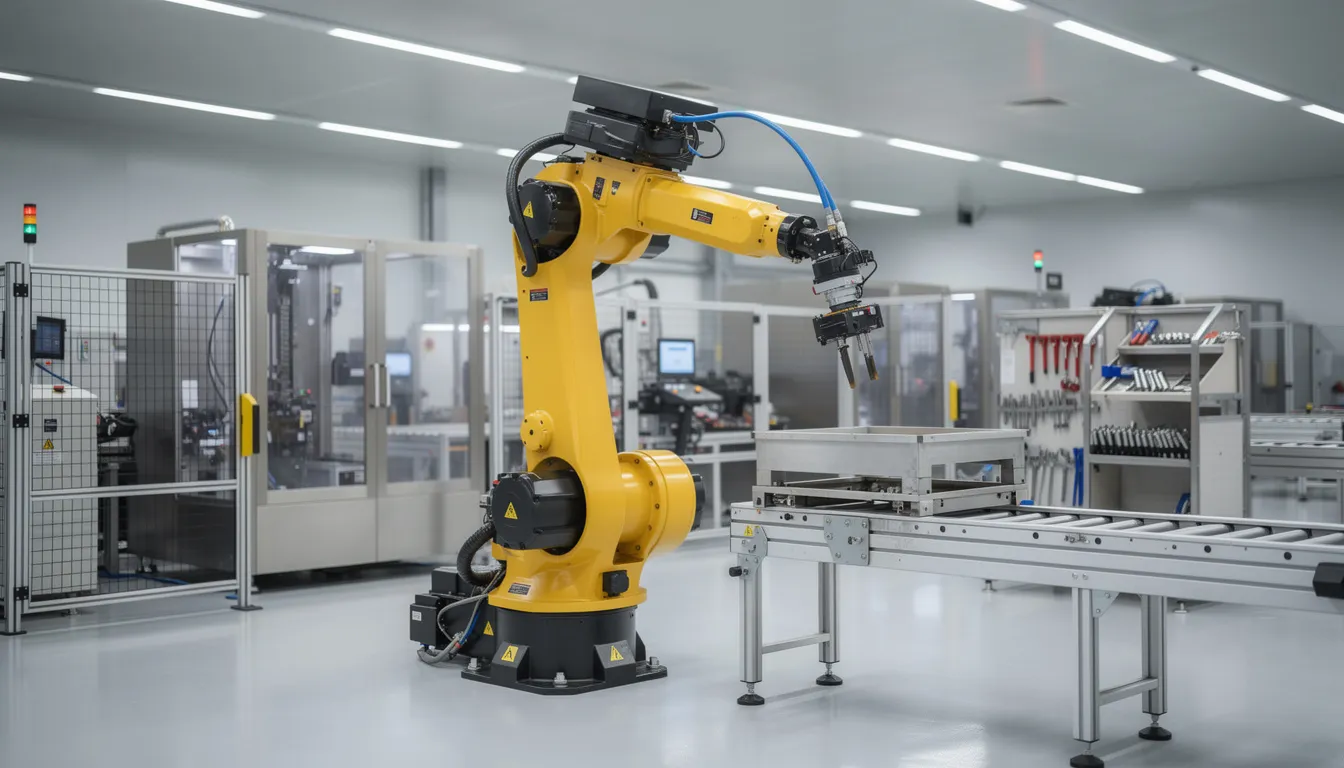
With real-world applications in mind, let's focus on autonomous systems, robotics, and embedded AI in C.
Autonomous Systems, Robotics, and Embedded C AI
Autonomous systems-drones, mobile robots, AGVs-typically rely on C/C++ stacks for real-time control, perception, and planning. The hard real-time requirements of physical systems demand the predictability that C provides.
Integration with Robotics Middleware
ROS 2 uses C++ for DDS middleware and core nodes
SLAM implementations run at 30 Hz with ORB features
Path planning algorithms execute thousands of expansions per second
2020s Examples of C-Based Robotics AI
Agricultural drones with C-based embedded vision for crop monitoring
Consumer robot vacuums running AI navigation firmware
Warehouse AGVs using real-time object tracking
Embedded AI on Microcontrollers
Platform | Runtime | Capability |
|---|---|---|
ARM Cortex-M55 | CMSIS-NN | 1 TOPS for gesture detection |
ESP32 | TFLite Micro | 10ms gesture inference |
Jetson Nano | CUDA/TensorRT | YOLO at 20 FPS |
Jetson Orin | TensorRT | 200 TOPS for full autonomy |
Hard real-time requirements-deterministic execution times, bounded memory, safety certification-keep C as the language of choice for self-driving cars and safety-critical robotics.
With embedded and robotics use cases established, let's address the ethical and security considerations unique to C AI systems.
Ethical and Security Considerations in C AI Systems
Bugs or unsafe defaults in C AI code can scale into large real-world impact when deployed on billions of devices. Even though C is “just an implementation detail,” design choices directly affect human intelligence interactions with AI technologies.
Systems-Level Ethical Considerations
Biased training data for embedded image recognition translates directly into hardware-level behaviors
Model decisions in control systems affect physical safety
Privacy violations can occur when sensitive user data is processed without proper handling
Security-Specific Concerns
Buffer overflows in C AI services processing untrusted inputs (images, audio, network traffic)
Memory corruption exploitable if model files are loaded from untrusted sources
Input parsers for ONNX or other formats as attack vectors
Secure Coding Practices for C AI
Bounds checking on all tensor operations
Use of AddressSanitizer (ASan) during development
Fuzzing input parsers with AFL++ (finds hundreds of vulnerabilities yearly)
Careful handling of model files loaded over networks
Privacy-preserving techniques at the systems level include running inference locally on-device to avoid sending raw user data to the cloud, encrypted model storage, and secure enclaves (Intel SGX) for sensitive AI computations.
With security and ethics in mind, let's move to resource management and performance optimization in C AI.
Resource Management and Performance Optimization
C AI development is as much about resource management as about AI algorithms. Optimization strategies determine whether your model meets latency budgets.
Memory Optimization
Contiguous buffers for all tensor data
Memory pooling to minimize allocation overhead
Aligning data to 64-byte boundaries for SIMD
Zero-copy techniques for GPU transfers
CPU Optimizations
Loop unrolling for inner computation kernels
Vectorization via AVX-512 intrinsics processing 16 floats per instruction
Compiler pragmas for auto-vectorization hints
Profiling with perf, VTune, or valgrind to identify hotspots
Concurrency Strategies
POSIX threads for parallel inference across 32 cores (achieving 16x speedup)
OpenMP pragmas for automatic parallelization
Custom allocators like tcmalloc reducing fragmentation by 50%
Careful synchronization to avoid contention
Energy Efficiency
INT8 quantization on ARM NEON saves 4x power versus FP32
Sleep/wake cycles tied to AI events in embedded firmware
Batch processing to amortize initialization costs
Model compression reducing memory bandwidth requirements
With optimization strategies in place, let's look ahead to the future trends shaping C in AI infrastructure.
Future Trends: C in the Next Wave of AI Infrastructure
As AI models grow and deployment moves closer to users-edge, browsers, cars-there is renewed demand for highly optimized C/C++ runtimes. The computing power needed for modern AI requires efficient execution.
Heterogeneous Computing Trends
CPUs + GPUs + NPUs + TPUs + custom ASICs in single systems
Unified SDKs like oneAPI providing C++ abstractions across hardware
AI frameworks generating C/C++ kernels for each target architecture
Emerging Hardware Platforms
Neuromorphic chips (Intel Loihi-2) running spiking networks with 1M neurons at 10x efficiency
Event-based vision sensors with C-like programming models
RISC-V processors with AI extensions targeted by TVM and other compilers
2023–2024 Lightweight Inference Engines
ONNX Runtime Mobile under 1MB for Llama-3.2-1B deployment
Meta’s ExecuTorch for PyTorch on-device with 4-bit INT4 quantization
Qualcomm AI Engine for mobile and XR inference
These infrastructure-level shifts rarely get front-page coverage, yet they matter deeply for C developers. Subscribing to a weekly, noise-cutting source like KeepSanity helps teams track exactly these developments without daily overload.
With future trends in mind, let's compare the main C-based AI libraries and approaches.
Comparison of C-Based AI Libraries and Approaches
Choosing between different C or C-centric approaches depends on project constraints: latency, memory, platform, and licensing requirements.
Category Comparison
Category | Examples | Best For |
|---|---|---|
Pure C libraries | FANN, Darknet | MCUs, minimal dependencies |
C++ with C roots | OpenCV, dlib | Computer vision, complex pipelines |
C APIs for frameworks | TensorFlow C, ONNX Runtime | GPU acceleration, broad model support |
Selection Criteria
Target hardware: MCU vs CPU vs GPU determines library choice
Footprint size: Kilobytes for microcontrollers, megabytes acceptable for servers
Training vs inference: Most C libraries focus on inference only
Integration ease: Existing build system and dependency management
Many teams mix approaches: prototype in Python with PyTorch, export to ONNX, deploy via C-based runtime in microservices or firmware. This workflow gives both development speed and production performance.
For most modern projects, using an existing C runtime and focusing effort on integration and optimization beats writing everything from scratch in raw C. Reserve pure-C implementations for educational purposes or severely constrained embedded targets.
With comparison points established, let's discuss how to stay up to date with C AI infrastructure developments.
Staying Up to Date Without Losing Your Sanity
AI infrastructure-new runtimes, kernels, edge accelerators-changes weekly, but daily newsletters often bury these updates under hype and sponsor-driven fluff. For C and systems developers, the signal is in major changes that actually affect compiled code.
What Matters for C Developers
New GPU architectures and driver updates
ONNX Runtime releases with performance improvements
Quantization breakthroughs for edge deployment
Compiler improvements affecting generated C/C++ AI code
We built KeepSanity to solve this problem: one tightly curated email per week, no ads, only high-impact AI news across AI models, infrastructure, AI tools, robotics, and trending papers relevant to engineering teams.
What You Get
Smart links (papers linked to alphaXiv for easy reading)
Clear categorization (business, infra, tools, robotics)
Summaries short enough for a busy C developer to scan in minutes
Zero sponsored content or daily filler
If you’re working with C artificial intelligence, subscribe at keepsanity.ai to track the AI infrastructure that matters to your code without drowning in daily noise.
Lower your shoulders. The noise is gone. Here is your signal.
FAQ
This section addresses common practical questions for engineers deciding whether and how to use C for AI work.
Is C still a good choice to learn for AI in 2024?
For most beginners, Python remains the fastest entry point into AI experimentation. However, C is highly valuable if you want to work on performance-critical systems, embedded AI, or runtime and compiler internals. Many AI jobs in infrastructure-at companies like NVIDIA, Meta, and Intel-require strong C/C++ skills to work on kernels, compilers, and low-level runtimes.
A practical learning path: master core machine learning concepts in Python first, then deepen into C by reimplementing small models and contributing to open-source AI libraries or inference engines like ONNX Runtime.
Can I build an entire AI application purely in C?
It is technically possible to implement data loading, training, and inference entirely in C, but it is rarely practical for large modern models due to ecosystem and tooling gaps. Most data science libraries and pre-trained deep learning algorithms are only available through Python APIs.
The common pattern is training using existing frameworks (from Python) and deploying the resulting model with a C-based runtime for inference. Pure-C implementations make sense for constrained embedded projects, educational experiments, or when external dependencies must be minimized for security or certification.
How do I deploy a Python-trained model into a C application?
The typical workflow: train a model in Python using PyTorch or TensorFlow, export it to ONNX or another portable format, then load it with a C/C++ runtime such as ONNX Runtime or TensorRT. The C application links against the runtime’s C API, initializes the model, feeds input tensors, and retrieves outputs using standard C types and buffers.
This approach combines the productivity of Python training with the performance and control of native C deployment-exactly how production teams at major tech companies structure their stacks.
What hardware should I target if I want to run C-based AI on the edge?
Popular targets include ARM Cortex-M and Cortex-A microcontrollers, Raspberry Pi-class boards, NVIDIA Jetson modules, and specialized AI accelerators from Qualcomm, NXP, or Google’s Edge TPU. Choose hardware based on power budget, memory capacity, and accelerator availability.
Then pick a C-friendly runtime supported on that platform: TensorFlow Lite Micro for constrained MCUs, ONNX Runtime Mobile for phones and tablets, or TensorRT for Jetson devices. Following hardware and SDK announcements through curated sources like KeepSanity helps avoid betting on short-lived or poorly supported platforms.
How can I keep up with low-level AI infrastructure changes without endless reading?
Most AI newsfeeds over-optimize for engagement, flooding readers with minor updates, online activity records, and repetitive headlines about the same product launches. A weekly, curated approach filters for only the most meaningful infrastructure, model, and tooling shifts.
Maintain a lightweight information diet: subscribe to one or two trustworthy, low-noise sources, skim release notes for the C-based runtimes you use, and avoid daily FOMO-driven scrolling. Your focus is a limited resource-protect it for the complex tasks that actually require human intelligence.