Artificial Intelligence Examples in Business
Key Takeaways
AI in business is mainstream in 2024-over 78% of organizations now use it for efficiency, decision making, and customer experience, up from 55% the year before.
This article focuses on concrete, real-world examples from companies like Amazon, McDonald’s, Netflix, and Moderna rather than abstract theory or hype.
AI delivers measurable value across customer service, marketing, operations, finance, HR, and industry-specific applications like healthcare diagnostics and manufacturing quality control.
The biggest wins come from pairing artificial intelligence with existing data and processes-not chasing every new tool announcement.
From KeepSanity’s perspective, business leaders should track only the few AI shifts that materially affect their operations, not every minor product update.
Introduction: How AI Is Actually Used in Business Today
Artificial intelligence isn’t new. Artificial intelligence (AI) refers to technologies designed to handle tasks that typically require human intelligence. Researchers were experimenting with pattern recognition and decision making systems in the 1950s and 1960s. Artificial intelligence (AI) is a category of technologies designed to handle tasks that typically require human intelligence, such as pattern recognition, decision making, and data analysis. But for most of its history, AI stayed locked in academic labs and defense projects-too expensive, too limited, and too abstract for everyday business.
That changed in the 2010s as cloud computing, cheaper GPUs, and vast datasets made machine learning practical at scale. Then came November 2022. When OpenAI released ChatGPT, it crossed a threshold: suddenly, non-technical people could interact with generative ai through plain natural language. The business world noticed.
Here’s where things stand now:
78% of organizations reported using AI in 2024, up from 55% the year before, according to Stanford’s 2025 AI Index Report.
The global AI market is projected to grow from roughly $200 billion in 2024 to over $1 trillion by the early 2030s.
Organizations put 11 times more ai models into production in 2024 compared to 2023.
In business, AI is less about sci-fi robots and more about pattern recognition: predicting demand, routing support tickets, detecting fraud, generating content, and optimizing supply chain management. These are routine tasks that humans can do-but AI does them faster, at scale, and often cheaper.
This article walks through practical examples across functions-customer-facing applications, operations, finance, HR, and industry-specific use cases. We’ll also cover risks, careers, and how to implement ai without drowning in the daily noise of new tool launches.
The tone here is pragmatic. We’re not going to hype every ai platform as revolutionary. Instead, we’ll focus on what actually works for businesses operate in the real world.

Customer Service and Support: AI at the Front Line
Customer support was one of the earliest and most impactful ai applications. The reasons are straightforward: high ticket volume, repetitive questions, and clear success metrics (resolution time, satisfaction scores, cost per ticket).
Conversational AI in Action
Retail and telecom companies now deploy customer service chatbots that handle order status inquiries, returns, and basic troubleshooting 24/7. These systems use natural language processing to understand what customers are asking and sentiment analysis to gauge frustration levels.
Here are concrete examples of how major brands use conversational ai:
Industry | Use Case | AI Function |
|---|---|---|
Banking | Virtual assistants answering account balance, payment, and fraud questions | NLP + intent classification |
Airlines | Chatbots handling booking changes, flight status, and FAQ | Automated routing + response generation |
Telecom | Support bots troubleshooting connectivity issues | Guided diagnostics + escalation |
Bank of America’s Erica, for example, handles millions of customer interactions monthly-everything from spending insights to bill pay reminders. Airlines like KLM use ai powered systems to manage booking changes across languages and time zones. |
Hybrid Models: Bots + Human Agents
The most effective implementations don’t try to replace human agents entirely. Instead, they use a hybrid approach:
AI resolves simple, repetitive tickets (password resets, order tracking, FAQs)
Complex issues route to customer service agents with AI-generated summaries
Agents receive suggested responses based on similar past tickets
This hybrid model is where most enterprise value comes from-not full automation, but intelligent augmentation.
Measurable Outcomes
When implemented thoughtfully, ai in business delivers clear results for support operations:
30-50% reduction in average handle time
Higher first-contact resolution rates
Significant cost savings per ticket (often 40-60% for automated interactions)
Improved customer satisfaction when bots handle simple queries quickly and escalate appropriately
The key is “thoughtfully.” Companies that deploy chatbots without proper training data or escalation paths often see customer satisfaction drop. The technology works-the execution determines outcomes.
Personalization and Recommendations: Turning Data Into Revenue
AI recommendation engines drove the growth of companies like Amazon and Netflix in the 2010s. By analyzing clicks, watch time, purchase history, and customer behavior, these systems surface products and content that users are statistically more likely to want.
Product and Content Recommendations
The same technology powers recommendations across industries:
Streaming services suggesting shows based on what you’ve watched, paused, or rewatched
Ecommerce sites surfacing “frequently bought together” and “you might also like” products
Music platforms creating personalized playlists from listening patterns
News apps prioritizing articles based on reading history
Amazon attributes roughly 35% of its revenue to its recommendation engine. Netflix estimates that personalization saves the company over $1 billion annually in reduced churn.
McDonald’s Automated Order-Taking
Between 2021 and 2024, McDonald’s tested ai powered systems at drive-thru locations. The goal: use natural language processing to understand spoken orders in multiple languages, reduce wait times, and improve accuracy.
The system faced real-world challenges-accents, background noise, complex customizations-that revealed the gap between lab performance and production deployment. McDonald’s eventually ended some pilots, but the experiment highlighted both the potential and the difficulty of deploying ai in high-volume, real-time customer interactions.
Advertising and Email Personalization
Beyond product recommendations, ai tools now personalize:
Email send times based on when individual users typically open messages
Subject lines and creatives selected from variations based on past engagement
Ad targeting that adjusts bids and audiences in real-time based on conversion data
These applications boost average order value, retention, and engagement by making every customer interaction feel more relevant-without requiring human intervention for each decision.
Marketing, Content, and Programmatic Advertising
Generative ai exploded into marketing workflows after 2023. What used to require days of copywriting and design iteration can now happen in minutes.
Content Generation at Scale
Marketers now use generative ai tools to:
Draft campaign copy, social media posts, and landing pages
Generate product descriptions for thousands of SKUs
Create image and video variations for different markets and audiences
Brainstorm headlines, taglines, and creative concepts
The tools aren’t perfect. Brand voice drift and hallucinations (confident-sounding but incorrect statements) remain risks. But for first drafts and iteration, they’ve dramatically accelerated time consuming tasks.
Programmatic Advertising
Ai systems have handled programmatic advertising for over a decade, but the sophistication keeps increasing:
Real-time bidding on digital ad inventory in milliseconds
Cross-channel optimization across display, social, search, and video
Predictive modeling for conversion likelihood and customer lifetime value
Dynamic creative optimization that assembles ad elements based on user context
Streaming and media companies use ai to adapt headlines and creatives to different markets. Ecommerce brands auto-generate product descriptions optimized for search and conversion.
Benefits and Cautions
Benefits | Cautions |
|---|---|
Speed: campaigns launch faster | Brand voice drift without oversight |
A/B testing at scale | Hallucinations and factual errors |
Better targeting from data analysis | Regulatory risks around ad transparency |
Lower cost per creative variation | Over-reliance on AI without human review |
The companies winning here use AI as a starting point, not a finished product. Human review, brand guidelines, and feedback loops remain essential. |
Operations, Supply Chain, and Predictive Maintenance
While generative AI gets the headlines, operational AI quietly delivers some of the highest ROI in large enterprises. These systems often predate ChatGPT by years.
Predictive Maintenance
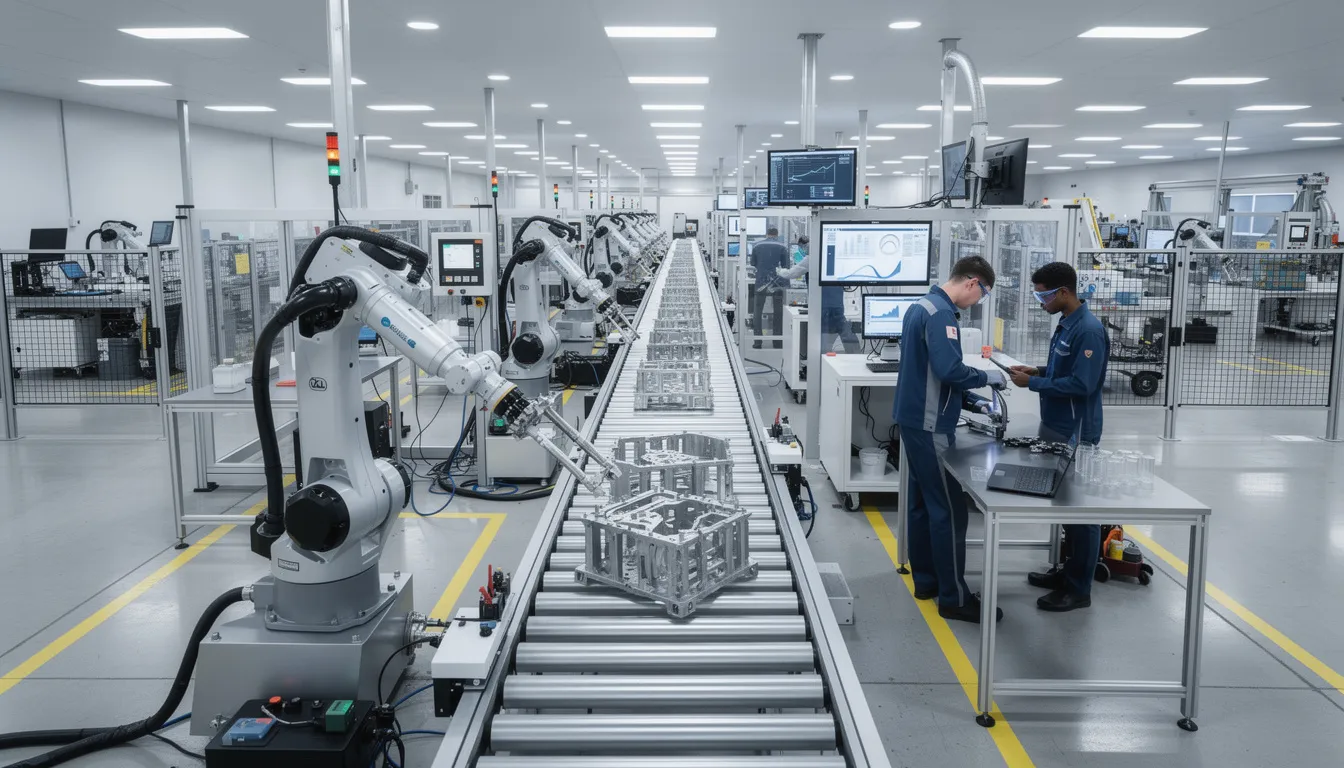
Manufacturing and logistics firms feed sensor data into machine learning algorithms that flag equipment at risk of failure:
Vibration patterns that indicate bearing wear
Temperature anomalies suggesting motor stress
Error logs that correlate with impending breakdown
The result: maintenance schedules shift from fixed intervals to condition-based predictions. Downtime drops. Maintenance costs fall. Asset lifespan extends.
Automotive plants adjust maintenance schedules based on real-time equipment data. Airlines predict engine component failures before they ground aircraft.
Supply Chain Optimization
Supply chain management became a board-level priority after COVID-19 exposed global fragility. AI now helps companies:
Forecast demand using historical sales, seasonality, promotions, and external signals (weather, economic indicators)
Optimize inventory management to balance stockouts against overstock costs
Route shipments dynamically based on traffic, fuel costs, and delivery windows
Predict disruptions from supplier risk data and geopolitical signals
Logistics companies optimize routes and container allocation using AI forecasts of shipping times. Retailers use ai solutions to adjust inventory across thousands of locations.
Why Operational AI Matters
These applications often lack the novelty of chatbots or image generators. But they address core operational efficiency where small percentage improvements translate to massive dollar savings.
A 2% improvement in demand forecasting accuracy can mean millions in reduced inventory costs for a large retailer.
Finance, Fraud Detection, and Risk Management
Banks and fintechs have used machine learning since at least the late 2000s. Financial services now shows the highest average GPU usage per company, with 88% growth in GPU utilization over just six months.
Fraud Detection
Credit card issuers scan millions of transactions per minute, comparing each against:
User purchase history and patterns
Geolocation and device data
Merchant risk profiles
Historical fraud patterns
When anomalies appear-a purchase in a new country, an unusually large transaction, a pattern matching known fraud techniques-the ai system flags or blocks the transaction in real-time.
Credit and Loan Decisioning
Lenders use AI to score applications based on:
Traditional credit history
Repayment patterns from alternative data sources
Income verification and employment stability
Behavioral signals from application interactions
This enables faster decisions and can expand access to credit for underbanked populations. However, fairness and regulatory compliance remain critical-biased training data can embed discrimination into ai algorithms.
Algorithmic Trading and Portfolio Management
At investment firms, machine learning model systems:
React to market data and news streams faster than human traders
Execute trades based on pattern recognition across vast datasets
Optimize portfolio allocation based on risk models
Monitor complex data for early signals of market shifts
Operational Finance
Beyond trading floors, finance teams use ai technology for:
Invoice matching and accounts payable automation
Expense categorization from receipt data
Cloud cost optimization (FinOps) to reduce infrastructure waste
Financial data anomaly detection for audit and compliance
Human Resources and Workforce Productivity
HR teams adopted AI for high-volume tasks like screening applicant pools, particularly after remote work expanded candidate funnels post-2020.
Applicant Screening
With hundreds or thousands of applications per opening, AI helps by:
Ranking resumes based on skills, experience, and role fit
Parsing qualifications from unstructured resume formats
Surfacing promising candidates for recruiter review
Scheduling interviews automatically
The goal isn’t to automate hiring decisions-it’s to help recruiters focus their time on candidates most likely to succeed.
Internal Support and HR Chatbots
AI answers common HR questions about:
Benefits enrollment and eligibility
PTO balances and policies
Payroll and tax documentation
Onboarding procedures
This frees HR staff from repetitive queries while providing employees with instant answers.
Performance Analytics
Some organizations use AI-assisted systems to:
Aggregate performance metrics (sales numbers, tickets resolved, project delivery)
Identify patterns in promotion and retention data
Give managers clearer baselines for reviews
Risks of Bias
HR AI requires special caution. Biased training data can embed discrimination into hiring, promotion, and performance systems.
Mitigation steps include:
Diverse and representative training data
Regular fairness audits
Human oversight for all final decisions
Transparency about how AI factors into evaluations
Business leaders should view HR AI as a tool for augmentation, not a way to remove human judgment from people decisions.
Industry-Specific AI Examples
Beyond general use cases, artificial intelligence is deeply embedded in specific verticals.
Healthcare
AI enables businesses in healthcare to:
Analyze radiology images for early detection of tumors, fractures, and anomalies
Triage patients through chatbot symptom checkers in telehealth
Accelerate drug discovery by narrowing candidate compounds
Pharmaceutical companies like Moderna leveraged AI to help design and test COVID-19 vaccine candidates, compressing development timelines that traditionally took years into months during 2020-2021.

Retail and Ecommerce
Retail applications include:
Dynamic pricing that adjusts based on demand, competition, and inventory
Visual search where customers upload photos to find similar products
Personalized shopping recommendations powered by customer behavior data
Inventory optimization across stores and fulfillment centers
Retail achieved the highest efficiency ratio in one study, putting 25% of experimental models into production.
Manufacturing and Robotics
Smart factories use:
Computer vision for quality inspection (detecting defects faster than human inspectors)
Narrow AI robots performing repetitive assembly and packaging
Predictive analytics for supply chain disruptions
Process optimization based on sensor and production data
Transportation and Mobility
Transportation applications include:
Route optimization for delivery fleets (minimizing fuel, time, and driver hours)
Ride-sharing matching that pairs drivers and passengers efficiently
Surge pricing algorithms that balance supply and demand
Self driving cars using computer vision and sensor fusion to navigate roads
Tesla’s autonomous driving system, Waymo’s robotaxis, and delivery drone pilots all represent the frontier-though full autonomy remains limited to specific conditions.
Challenges and Risks of Using AI in Business
AI’s benefits come with nontrivial risks. Business leaders must manage these deliberately rather than hoping they won’t materialize.
Bias and Fairness
Biased training data leads to discriminatory outcomes. This appears in:
Credit scoring that disadvantages certain demographics
Hiring systems that favor candidates similar to historical employees
Facial recognition with higher error rates for certain groups
Mitigation steps:
Diverse and representative datasets
Fairness toolkits and regular audits
Human review of high-stakes decisions
Transparency about how models are trained
Privacy and Data Protection
Data-hungry models raise concerns around:
Customer data collection and use
Compliance with GDPR, CCPA, and other privacy frameworks
Data retention and deletion policies
Third-party data sharing with AI vendors
Organizations must ensure clear data governance before deploying ai models.
Workforce Disruption
Automation risk is real for repetitive roles. However, the picture is more nuanced than “robots taking jobs”:
Large tech and logistics firms are investing billions in reskilling employees
Many AI implementations augment workers rather than replace them
New roles emerge (prompt engineers, AI trainers, ethics specialists)
The 70-20-10 principle: 70% of AI implementation challenges come from people and process issues, 20% from technology, and only 10% from algorithms themselves.
Transparency and Security Risks
Other concerns include:
Black-box decisions in high-stakes areas (healthcare diagnosis, loan approvals)
Adversarial attacks that manipulate AI systems
Deepfakes and misinformation enabled by generative AI
Security risks from AI systems with broad data access
Explainability, cybersecurity, and content authenticity checks are essential for responsible deployment.
AI Skills and Career Paths in Business
As AI adoption grows, demand for AI-fluent professionals rises across technical and non-technical roles.
Technical Roles
Role | Focus |
|---|---|
AI Engineer | Building and deploying ai system infrastructure |
Machine Learning Engineer | Developing and optimizing machine learning model performance |
Data Scientist | data analysis, pattern discovery, model development |
MLOps Engineer | Managing models in production, monitoring, versioning |
Pursuing an ai master’s degree or specialized certifications can accelerate entry into these roles. |
Business-Adjacent Roles
Prompt Engineers who optimize interactions with generative ai tools
Marketing Technologists who integrate AI into campaigns
Operations Analysts who deploy ai models for forecasting and optimization
Ethical AI Specialists who audit systems for bias and compliance
Job Outlook
The Bureau of Labor Statistics projects hundreds of thousands of new computer and IT roles annually through the early 2030s. Demand for AI-adjacent skills spans it teams, product management, and business strategy.
Business leaders don’t all need to code. But they need literacy: understanding what AI can and cannot do, how to frame use cases, and how to evaluate ROI and risk.
How to Start Using AI in Your Business (Without Drowning in Noise)
AI news moves at a dizzying pace. New tools launch daily. Hype cycles spin. Many teams feel overwhelmed.
Here’s a more focused approach:
Start With 2-3 High-Impact Use Cases
Don’t experiment randomly with dozens of ai software products. Instead, identify where AI solves a real problem:
Customer support automation (clear metrics: tickets resolved, cost per interaction)
Sales enablement (lead scoring, follow up messages, CRM intelligence)
Demand forecasting (inventory costs, stockout reduction)
Use a Phased Approach
Identify a measurable problem with existing data
Pilot an ai assistant or tool with a small team
Track clear KPIs (cost savings, time saved, conversion lift)
Scale if results justify broader rollout
Centralize AI Governance
Avoid chaos by creating:
An internal AI working group that evaluates tools
Clear policies for data use, vendor evaluation, and security risks
Shared best practices across departments
Follow Curated Updates, Not Daily Noise
This is where KeepSanity’s philosophy applies: you don’t need daily tool announcements to succeed with AI. Most daily news is filler-minor updates padded to keep you engaged with newsletters that serve sponsors, not readers.
AI leaders pursue, on average, only about half as many opportunities as their less advanced peers-yet expect more than twice the ROI.
Focus on substantial shifts: major model releases, regulatory changes, and proven enterprise case studies. One curated weekly update beats daily noise.

FAQ
What are the fastest ROI AI use cases for a small or mid-sized business?
Typical fast-ROI applications include virtual assistants for customer support, AI-assisted marketing copy and ad creation, sales enablement features inside CRM tools, and invoice or expense automation. These work well because they plug into existing workflows and data, require minimal custom modeling, and have clear cost and time-savings metrics. Start with off-the-shelf tools integrated into platforms you already use-helpdesk software, email marketing tools, accounting systems.
Do I need a data scientist to start using AI in my company?
Many modern ai tools are “no-code” or “low-code,” allowing smaller teams to begin without hiring a full data science team. An ai simulator or built-in ai agents in your existing software can handle many use cases. A data scientist or ML engineer becomes more important when building custom models, integrating multiple data sources, or operating at large scale. Non-technical leaders should still invest in basic AI literacy to evaluate vendors, understand limitations, and avoid unrealistic expectations.
How should I address employee concerns about AI replacing their jobs?
Communicate transparently that AI is intended to remove routine tasks and augment employees, not secretly replace them overnight. Invest in training programs that teach staff how to use ai driven solutions in their roles-drafting emails, analyzing reports, brainstorming ideas. Involve employees in pilot projects so they help design workflows. This builds trust, surfaces better real world examples of useful applications, and reduces resistance.
What data do I need before implementing AI in my business?
The “right” data depends on the use case: support chat logs for customer service bots, transaction histories for fraud detection, sensor data for predictive maintenance. Start with data you already gather data on consistently, even if imperfect. You can improve data quality over time. Ensure clear ownership, governance, and compliance processes around any customer or operational data used for AI-especially when handling financial data or human intelligence about employees.
How can I keep up with important AI developments without wasting time?
Following every daily announcement is counterproductive. Instead, track only the handful of shifts that change ai capabilities, costs, or regulations in a meaningful way. Subscribe to a curated weekly digest that filters out minor feature launches and focuses on substantial model releases, business case studies, and policy changes. This approach aligns with KeepSanity’s philosophy: one focused, ad-free update per week that preserves attention while keeping decision-makers informed. Lower your shoulders. The noise is gone. Here is your signal.